Writing a Winning Proposal: A Guide to Accessing Poultry Farming Grants
Accessing funding is a critical step for poultry farmer groups aiming to expand operations, improve efficiency, or adopt new technologies. A well-crafted proposal is your key to unlocking these opportunities. Inspired by organizations like KEPOFA, which offer proposal writing services to facilitate access to donor funding, this guide provides a practical roadmap for developing compelling grant applications.
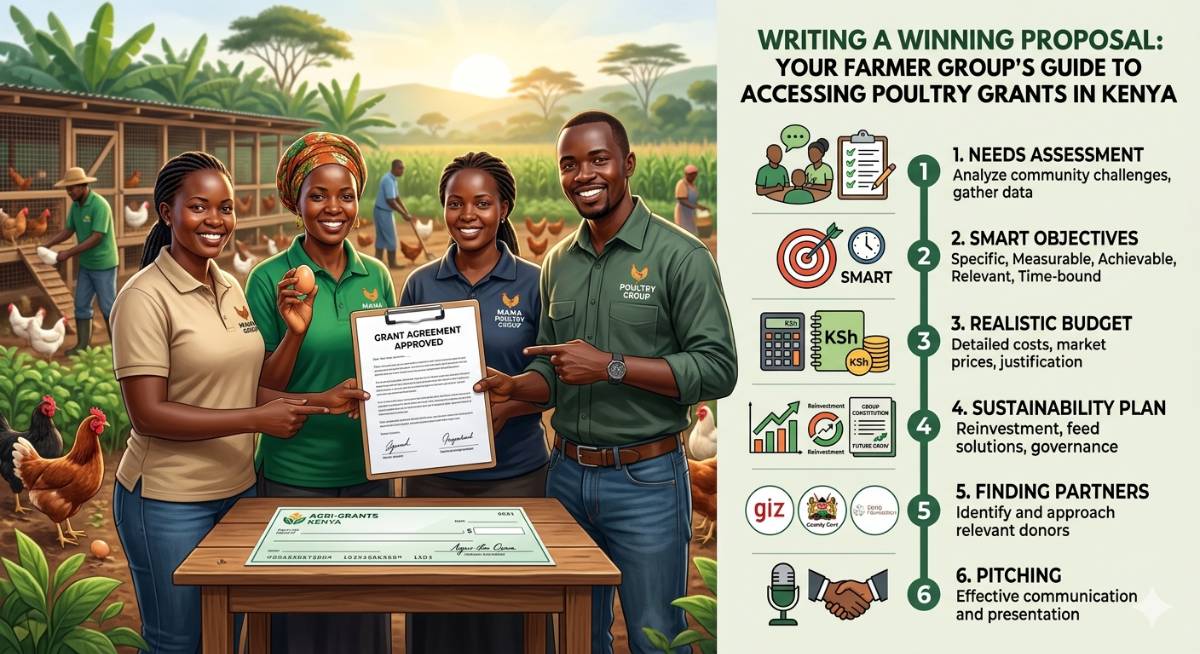
1. Needs Assessment: Laying the Foundation
Every successful proposal begins with a clear and concise needs assessment. This section demonstrates that you understand the challenges facing your group and the broader poultry sector. Don’t simply state problems; provide evidence.
Data is Key: Include statistics on current production levels, market access limitations, feed costs, disease prevalence, and income levels of group members.
Local Context: Tailor the needs assessment to your specific region and the unique constraints faced by local farmers.
Example: “Our group of 20 farmers currently loses 15% of broiler chicks due to preventable diseases like Newcastle. This is due to limited access to affordable vaccines and veterinary services within a 50km radius.”
2. Defining Clear Objectives: The Roadmap to Success
Objectives outline what your project will achieve. They should be SMART: Specific, Measurable, Achievable, Relevant, and Time-bound.
Specific: Avoid vague statements like “improve poultry farming.” Instead, state “increase broiler production by 20%.”
Measurable: How will you track progress? (e.g., number of chicks vaccinated, kilograms of feed produced).
Achievable: Be realistic about what you can accomplish with the requested funding.
Relevant: Align objectives with the identified needs and the donor’s priorities.
Time-bound: Set clear deadlines for each objective. (e.g., “within 12 months”).
Example: “By December 31, 2024, our group will vaccinate all 5,000 broiler chicks against Newcastle disease, resulting in a 15% reduction in chick mortality.”
3. Detailed Budget: Transparency and Accountability
The budget is a crucial component. It demonstrates responsible financial planning.
Itemize Costs: Break down all expenses into clear categories (e.g., vaccines, feed, equipment, labor, training, transportation).
Realistic Pricing: Research current market prices to ensure your budget is accurate.
Justification: Provide a brief explanation for each cost.
Contingency: Include a 5-10% contingency fund for unforeseen expenses.
Example:
Item
Quantity
Unit Cost (KES)
Total Cost (KES)
Justification
Newcastle Vaccine
5,000
5
25,000
Vaccinating all chicks
Chick Feed
2 tons
30,000
60,000
Providing adequate nutrition
Training Workshop
20
2,000
40,000
Training on best poultry practices
4. Sustainability Plan: Ensuring Long-Term Impact
Donors want to know that your project will continue to benefit the community after the funding ends. A sustainability plan outlines how you will achieve this.
Financial Sustainability: How will you generate income to cover ongoing costs?
Technical Sustainability: Will group members have the skills and knowledge to maintain the project independently?
Environmental Sustainability: How will you minimize the environmental impact of your operations?
Community Ownership: Demonstrate that the local community is invested in the project’s success.
Example: “Our group will establish a revolving fund using a portion of the generated profits to purchase vaccines and feed for future production cycles. We will also partner with a local veterinarian to provide ongoing technical support.”
5. Finding and Pitching to Development Partners
Research: Identify potential donors whose priorities align with your project. Explore websites like KEPOFA (https://kepofa.org/) for a list of development partners.
Tailor Your Proposal: Customize your proposal to each donor’s specific guidelines and requirements.
Networking: Attend industry events and connect with donor representatives.
Follow Up: After submitting your proposal, follow up to inquire about its status.
Conclusion
Securing grant funding for your poultry farming group requires dedication and a well-structured proposal. By focusing on a clear needs assessment, SMART objectives, a transparent budget, and a robust sustainability plan, you can significantly increase your chances of success. Don’t hesitate to seek guidance from organizations like KEPOFA to refine your proposal and navigate the funding landscape. Start planning today and unlock the potential for growth and sustainability!
Poultry Market Kenya is a dedicated poultry farming and agribusiness blog focused on empowering farmers, traders, and agri-entrepreneurs across Kenya. We publish practical, data-driven content covering poultry production, disease management, feeding strategies, housing, equipment reviews, and market insights.
Our goal is to bridge the gap between traditional poultry farming practices and modern, profitable methods by providing reliable information, expert guidance, and real-world case studies.