A hen that looks healthy from a distance can still be quietly losing condition to an organism you cannot see. By the time a farmer notices pale combs, dropped egg production, or birds scratching endlessly against the walls of the coop, parasites have often been working for weeks. Understanding the types of parasites in chickens — and knowing which ones live on the bird versus inside it — is one of the most practical health skills any poultry keeper can develop.
Parasites are generally divided into two groups: external parasites (ectoparasites), which live on the skin and feathers, and internal parasites (endoparasites), which live inside the body, usually in the digestive tract. Each group behaves differently, causes different damage, and requires a different control approach.
External Parasites: The Threats on the Surface
External parasites feed on blood, skin, and feathers. Because they live on or around the bird, they are often the easiest to detect — if you know where to look.
Mites
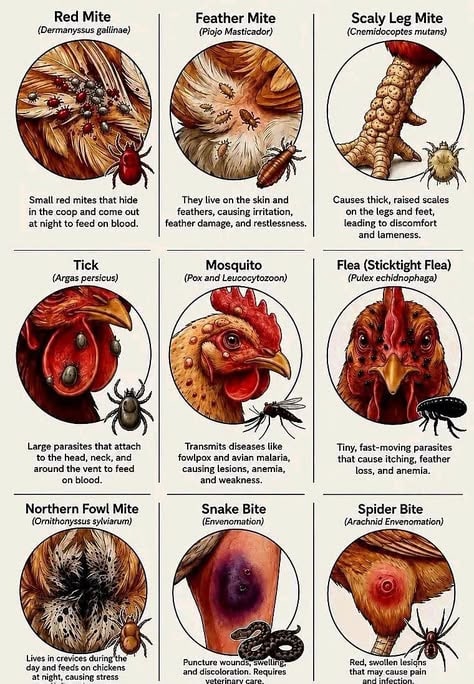
Mites are among the most damaging ectoparasites in poultry. The northern fowl mite (Ornithonyssus sylviarum) is considered the most common external parasite of poultry, particularly in cooler weather. It is a blood feeder, and heavy infestations can cause anemia, reduced egg production, and even death in severe cases. You will usually find these mites clustered around the vent area, where the feathers appear dirty or crusted.
The scaly-leg mite works differently. It burrows under the scales of the legs and feet, causing the scales to lift and thicken. Affected birds may become lame, and the condition worsens slowly if ignored.
Lice
Several species of biting (chewing) lice infect poultry. Unlike mites, lice do not suck blood — they feed on skin debris and feathers, and they spend their entire life cycle on the host. The chicken body louse (Menacanthus stramineus) is probably the most common in chickens. While lice rarely kill birds directly, heavy infestations cause irritation, restlessness, reduced feeding, and a noticeable drop in laying.
Other external pests
Fleas, ticks, and bedbugs can also trouble poultry, particularly in free-range or backyard systems where birds contact wild birds, rodents, or contaminated housing. These pests often hide in cracks in the coop during the day and feed on birds at night, which is why a coop inspection after dark can reveal problems you would never see at midday.
Have you ever examined your coop at night with a flashlight? Many farmers are surprised by what they find.
Internal Parasites: The Hidden Drain on Your Flock
Internal parasites are harder to spot because the damage happens inside the bird. The major groups that affect poultry are nematodes (roundworms), cestodes (tapeworms), trematodes (flukes), and acanthocephalans (thorny-headed worms). Coccidia — microscopic protozoan parasites — are another major internal threat, especially in young birds.
Roundworms (nematodes)
Roundworms are the most frequently encountered internal worms in backyard flocks. They live in the intestines and compete directly with the bird for nutrients. Heavy burdens cause weight loss, poor growth, pale combs, and reduced egg output. Some species, like the cecal worm, can also carry other disease organisms, making a seemingly mild worm problem more dangerous than it appears.
Tapeworms (cestodes)
Tapeworms attach to the intestinal wall and absorb nutrients through their bodies. Many tapeworm species require an intermediate host — such as beetles, earthworms, ants, or snails — to complete their life cycle. This is an important practical point: birds raised entirely indoors on concrete are far less likely to pick up these worms, while free-range birds foraging on the ground face much higher exposure.
Why free-range birds face higher risk
This is not an argument against free-range systems — it is an argument for managing them properly. Because many worm species exist in reservoirs among wild and backyard birds, and because their intermediate hosts live outdoors, a flock with access to pasture will naturally encounter more parasite pressure than a confined flock. If you keep indigenous or improved kienyeji chickens on open ground, regular monitoring is not optional; it is part of the production system.
How to Identify a Parasite Problem
You do not need a laboratory to catch many infestations early. A routine physical check tells you a great deal:
- Part the feathers around the vent, under the wings, and on the breast. Look for moving mites, lice, or clusters of eggs (nits) glued to feather shafts.
- Examine the legs for lifted, crusty scales suggesting scaly-leg mites.
- Watch the droppings. Worms are sometimes visible in fresh droppings, and persistent diarrhea or bloody droppings in young birds can indicate coccidiosis.
- Track performance. Unexplained drops in egg production, poor weight gain, pale combs, or birds that eat well but stay thin all point toward internal parasites.
For confirmation, fecal testing through a veterinarian or diagnostic service identifies internal parasites before major symptoms appear, while skin scrapings and feather examinations detect external ones. This is far cheaper than treating an advanced outbreak.
Practical Prevention and Control
The most effective parasite programs combine sanitation, management, and targeted treatment rather than relying on any single tool.
- Clean and dry the coop regularly. Mites and many worm eggs thrive in damp, dirty litter.
- Provide dust baths. Birds use dry soil or ash to suffocate external parasites naturally — a free control method every flock should have access to.
- Manage pastures. Rotate ranging areas where possible, avoid overcrowding, and keep wild birds away from feed and water.
- Quarantine new birds. A single infested bird can seed mites or worms through an entire flock.
- Deworm strategically, not blindly. Base treatment on fecal results or confirmed signs, and always follow the guidance of a qualified veterinarian on product choice and dosage. Overuse of dewormers encourages resistance, and incorrect dosing wastes money while leaving birds unprotected.
One common mistake is treating the birds but ignoring the environment. Many mites survive off the host in coop cracks and bedding, so treating the bird alone often means reinfestation within weeks.
The Bottom Line
Parasites rarely announce themselves loudly. They work quietly — stealing nutrients, blood, and productivity — until the losses become impossible to ignore. The farmers who stay ahead of them are not the ones with the most medicine; they are the ones who inspect their birds regularly, keep housing clean and dry, and test before they treat.
Start this week: pick up three birds, check the vent feathers and legs, and look closely at the droppings in the morning. That ten-minute habit can protect your entire season's output.
If you found this guide useful, share it with a fellow poultry keeper who might be scratching their head over unexplained production drops — the answer may be smaller than they think. We would also love to hear from you: which parasites have given your flock the most trouble, and what worked for you? Drop your experience in the comments, and follow Poultry Market for more practical, farmer-first poultry health content.