Imagine walking into your layer house one morning and noticing something odd: egg production has dipped slightly, a few birds look pale around the comb, and when you part the feathers near the vent of one hen, you see tiny moving specks and dark crusty debris. You have not changed the feed. The water is clean. Yet something is quietly draining your flock — and it is probably an ectoparasite.
External parasites are among the most underestimated problems in poultry production. They rarely kill birds outright, but they reduce egg output, cause anemia, irritate birds into restlessness, and in some cases transmit infectious diseases such as Pasteurella multocida. Understanding how to identify, detect, and control them is one of the most cost-effective skills a poultry keeper can develop.
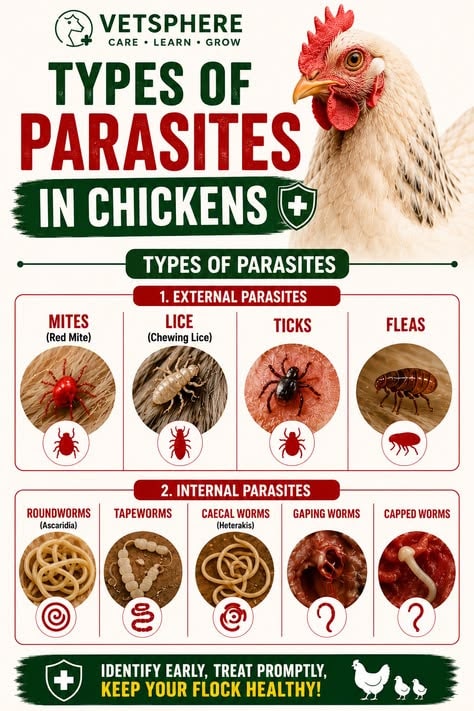
The Main Ectoparasites You Should Know
Not all mites and lice behave the same way, and that difference matters enormously for control.
Mites
Northern fowl mite (Ornithonyssus sylviarum) lives on the bird permanently. It concentrates around the vent region, and heavy infestations produce a characteristic picture: anemia, scabby dermatitis near the vent, and a blackened, dirty appearance caused by mite exoskeleton casts and excreta. Because these mites spend their entire life on the bird, treatment must reach the bird itself — particularly the vent area.
Red mite (Dermanyssus gallinae) behaves very differently. It feeds on birds only at night, then hides during the day in nests, cracks, and crevices in the house. Its life cycle can be as short as 7–10 days, and it can survive off the birds for about a month. This means treating only the birds will fail; you must also treat the structure. Have you ever noticed your birds reluctant to enter the house at night? Red mites are a classic cause.
Scaly leg mite (Knemidocoptes mutans) burrows under the scales of the legs and feet, causing raised, crusty, thickened scales and, in severe cases, lameness and deformity. Diagnosis is confirmed by examining skin scrapings cleared in 10% potassium or sodium hydroxide under a microscope.
Other mites occasionally cause trouble too — Cytodites nudis can invade the air sacs, for instance — but the three above account for most of the economic damage.
Lice and Ticks
Poultry lice chew on skin debris and feathers rather than sucking blood, but heavy infestations still reduce condition and egg output. Ticks, including soft ticks of the Argas group, feed intermittently, hide in housing between meals, and can transmit disease. Free-range and village systems, common across Kenya, tend to carry heavier ectoparasite burdens than confined commercial units, where parasites are usually controlled even if never fully eradicated.
How to Detect an Infestation Early
Early detection is where most farmers either save money or lose it. Build a simple routine:
- Handle birds weekly. Pick up a sample of birds and part the feathers around the vent, under the wings, and on the breast. Look for moving mites, lice, eggs glued to feather shafts, and blackened debris.
- Inspect at night with a torch. Red mites feed after dark. A quick night visit often reveals what a daytime inspection misses.
- Check the structure. Examine cracks, perch ends, nest box joints, and cage fittings for hiding mites or telltale grey-red smears.
- Watch production and behavior. Unexplained drops in egg output, pale combs, feather pecking, restlessness, and birds avoiding the roost are all warning signs.
- Examine the legs. Raised, crusty scales suggest scaly leg mite; a skin scraping examined by a veterinarian or laboratory confirms it.
Laying flocks generally suffer more than broilers, simply because they live long enough for parasite populations to build up. If you keep layers, your inspection routine matters even more.
Control: Think Integrated, Not Just Chemical
Here is an uncomfortable truth from the research literature: mite populations are often resistant to most available acaricides, so chemical treatment alone rarely eliminates them. Effective control is integrated.
Sanitation and Housing Management
- Clean and disinfect houses thoroughly between flocks, paying attention to cracks and crevices where red mites hide.
- Remove litter, manure, and debris promptly; these shelter pests.
- Seal or repair cracks in woodwork and consider smooth, washable surfaces where feasible.
- Quarantine and inspect new birds before introducing them to your flock.
- Manage wild bird and rodent access, since both can introduce parasites.
Chemical Control — Used Correctly
When acaricides or insecticidal dusts are used, success depends on delivery. Because northern fowl mites cluster around the vent, the treatment must actually reach the skin in that region — a light spray over the back feathers will not do the job. For red mites, treat the house, nests, and crevices as well as the birds. Always follow the product label, observe withdrawal periods for eggs and meat, and rotate products where resistance is a concern. When in doubt, consult a veterinarian or animal health officer rather than guessing at doses.
Monitoring After Treatment
Re-check birds and housing one to two weeks after any treatment. Because red mites can survive off the host for weeks and eggs may hatch after treatment, a single application seldom finishes the job.
Venomous Bites and Stings: Rare but Real
Venomous bites — from snakes, spiders, or scorpions — are uncommon in poultry, but they do occur, especially in free-range systems and in houses with gaps, stored equipment, or dark corners where these animals shelter. A bird that has been bitten or stung may show sudden swelling, localized pain, weakness, difficulty breathing, or sudden death, depending on the species involved.
What can you actually do?
- Prevention is the main tool. Keep the area around the house clear of rubbish, stacked timber, and tall grass. Seal holes in walls and floors. Control rodents, which attract snakes.
- Isolate and support the affected bird. Move it to a quiet, clean, warm space with easy access to water. Stress worsens outcomes.
- Seek veterinary help promptly. Do not attempt home remedies, incisions, or unverified treatments. There is no reliable published first-aid protocol for envenomation in poultry, and honest advice here is limited: supportive care and professional assessment give the bird its best chance.
If you farm in a region where snakes are common, it is worth asking your local veterinarian in advance what they recommend, so you are not improvising during an emergency.
Putting It Together
Ectoparasite control is not a one-off event; it is a routine. The farmers who stay ahead of mites and lice are the ones who handle their birds regularly, inspect at night occasionally, clean thoroughly between flocks, and treat both the bird and the building when problems appear. For venomous bites, prevention through good housekeeping around the poultry house does nearly all the work.
Have you checked your flock's vent feathers this week? It takes five minutes and can save you an entire laying cycle's profit.
If you found this guide useful, follow Poultry Market (https://www.poultrymarket.app) for more practical poultry health content, share it with a fellow farmer who keeps layers, and drop a comment about the parasite problems you have dealt with — your experience might be exactly what another farmer needs to hear.