Walk into any farmers' market with a basket of blue, chocolate brown, and olive eggs, and you'll draw a crowd. Walk in with plain white eggs and you'll compete on price alone. That's the quiet power of egg shell color — it doesn't change what's inside the egg, but it can absolutely change how your eggs sell, who buys them, and what premium you can ask.
If you've ever wondered why one hen lays a deep chocolate egg while another lays something that looks dyed blue, the answer comes down to breed genetics. And once you understand how it works, you can plan your flock around the exact egg basket you want to offer your customers.
What Actually Determines Egg Color
Every egg starts out white. The shell itself is made of calcium carbonate, which is naturally white. Color gets added during the final hours of egg formation in the shell gland, and the pigments involved depend entirely on the hen's genetics.
Two pigments do most of the work:
- Protoporphyrin — produces brown and reddish-brown tones, deposited on the outer shell surface late in formation. This is why brown eggs are often white inside the shell if you crack one open.
- Oocyanin — a blue pigment that permeates the entire shell, which is why blue eggs are blue all the way through.
Here's the part many new farmers get wrong: shell color has nothing to do with nutrition or flavor. A blue egg and a white egg from hens fed the same diet are essentially identical inside. What changes eating quality is feed, freshness, and how the bird is raised — not the shell.
The Breeds Behind the Colors
Blue and Blue-Green Layers
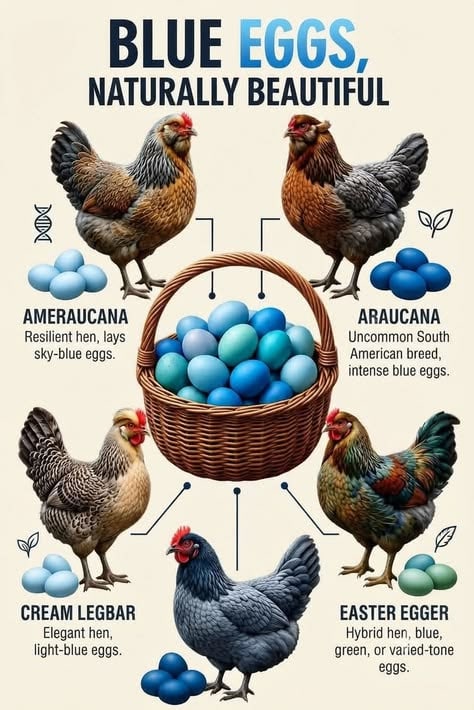
Ameraucana hens are the reliable workhorses of the blue egg world, laying blue to turquoise eggs at roughly 250–300 eggs per year. They're calm, friendly birds that suit small-scale and backyard setups well.
Araucana hens lay pale to bright blue eggs, but production is lower — around 150 eggs annually — and the breed carries genetic quirks that make them trickier to breed true. They're often kept for exhibition as much as for eggs.
Cream Legbar is another strong blue-egg layer with the bonus of being auto-sexing, meaning you can tell males from females at hatch — a real advantage if you're hatching your own chicks.
Chocolate and Dark Brown Layers
When people talk about dark eggs, Marans dominate the conversation. French strains of this breed produce some of the darkest chocolate-brown eggs in the world, and those eggs are highly sought after by specialty buyers and backyard keepers. One honest caveat: Marans eggs tend to darken and lighten across the laying cycle, and egg darkness can vary between individual hens. If you're buying Marans stock for dark eggs, ask the breeder about the actual egg color of the parent line — not just the breed name.
Welsummers and Barnevelders also lay rich brown, sometimes speckled eggs, and they tend to be hardy, decent foragers.
Olive and Green Eggs
There's no ancient "olive egg breed" — olive eggers are crosses, typically a blue-egg layer bred with a dark brown-egg layer (for example, Ameraucana × Marans). The blue shell base plus a brown pigment coating produces olive green. This is worth knowing because it means you can create your own olive eggers if you keep a rooster from one color line and hens from another.
White and Classic Brown
For commercial-scale thinking, white egg strains are largely developed from the Single Comb White Leghorn, while commercial brown egg strains trace mainly to crosses involving Rhode Island genetics. These birds were selected for volume, feed efficiency, and shell quality — not novelty. If your market is price-sensitive and volume-driven, they remain hard to beat.
Choosing Breeds for Your Market
This is where the decision gets practical. Ask yourself: who is buying your eggs, and what do they value?
Scenario one: You supply a supermarket or local shop where eggs move on price. Colored eggs won't earn you extra here. High-production brown or white layers with strong feed conversion make the most sense.
Scenario two: You sell directly — at the farm gate, through social media, or to restaurants and specialty grocers. A mixed basket of blue, chocolate, olive, and speckled eggs becomes a genuine marketing tool. Customers remember it, photograph it, and come back for it.
A few practical points before you commit:
- Production trade-off is real. Many colored-egg breeds lay fewer eggs per year than commercial strains. Ameraucanas are the exception; Araucanas and Marans lay notably less. Fewer eggs per hen means you need more hens (and more feed) for the same output.
- Feed costs don't care about egg color. A Marans eats roughly what a Leghorn eats. Run the numbers: if a hen consumes about 120 grams of feed per day, 50 hens eat roughly 6 kg daily — about 180 kg per month — regardless of shell color. Colored eggs only make financial sense if your market actually pays a premium for them.
- Temperament matters for mixed flocks. Breeds like Ameraucanas are calm and integrate well; some exhibition lines are flightier. Mixed-color flocks work best when temperaments are compatible.
- Buy from breeders who show you the eggs. Egg color is heritable but variable. The hen's own egg is the best predictor of what her daughters will lay.
What does your current market actually reward — volume, or uniqueness? That single question should drive your breed choice more than any beautiful photo online.
A Note for Small-Scale and Dual-Purpose Farmers
If you're farming at homestead level, local and improved dual-purpose birds deserve mention. Improved dual-purpose breeds grow faster, carry less fat, and lay more eggs than local birds while keeping the hardiness and scavenging ability that makes free-range systems work. Most lay brown-tinted eggs rather than exotic colors — but their low input costs and resilience often matter more to a smallholder's bottom line than shell novelty. Colored-egg breeds can be added gradually as a small premium line alongside a dependable base flock, rather than replacing it.
The Bottom Line
Egg color is genetics made visible. Blue comes from oocyanin, chocolate from protoporphyrin, olive from crossing the two — and none of it changes what's inside the shell. What it changes is your marketing. Match your breeds to your buyer: commercial strains for volume markets, colored-egg breeds for direct and specialty sales, and always check the production numbers before falling in love with a pretty shell.
Have you tried selling colored eggs in your area — did customers actually pay more for them? Share your experience in the comments; other farmers weighing the same decision will learn from it. And if you know someone building their first layer flock, pass this along. Follow Poultry Market for more practical, no-nonsense poultry guidance you can use on your farm this week.