Target Audience: Kenyan poultry farmer groups, cooperatives, and smallholder farmers seeking funding for their farming ventures.
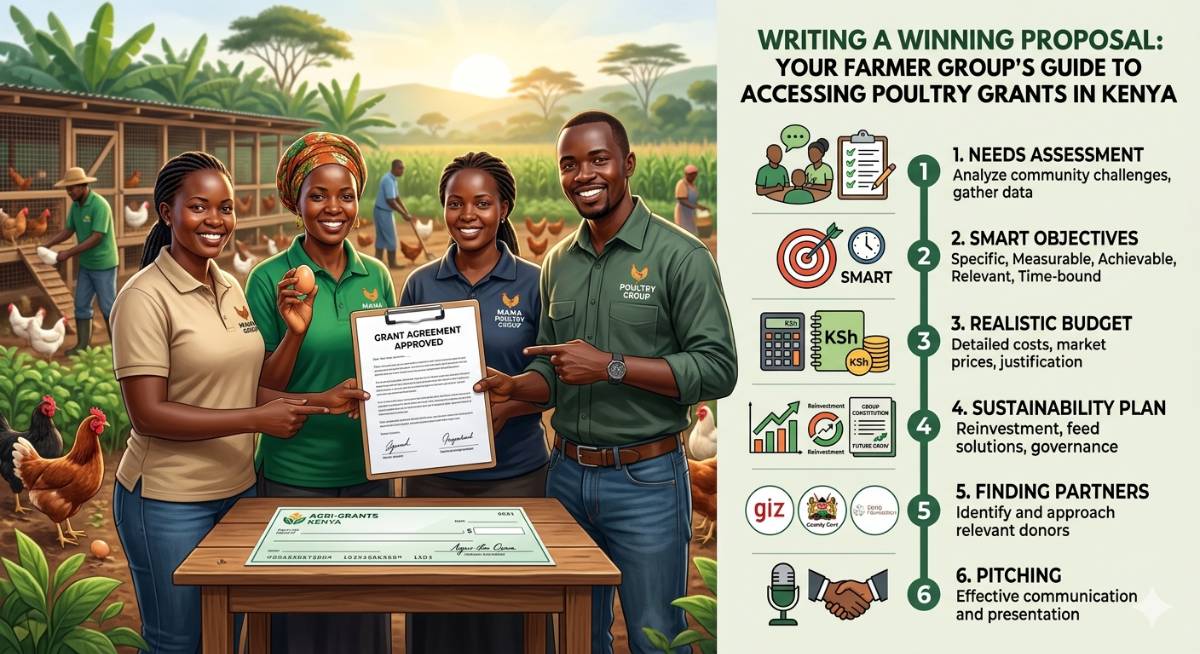
Summary: Securing funding for your poultry project can often feel overwhelming. This guide breaks down everything you need to know, from conducting a practical needs assessment and crafting a SMART objective to building a realistic budget and designing a sustainability plan that donors love. It also shows you exactly where to find poultry grants in Kenya and how to pitch your project effectively to development partners such as GIZ, the Ford Foundation, and county governments.
Introduction: The One Skill That Unlocks Funding
"Eight community-managed groups across eight villages have received grants... The groups designed their own proposals, ensuring the projects were sustainable, measurable and rooted in recovery."— Golicha Wario, Senior Programmes Officer at Strategies for Northern Development (SND)
That quote captures a vital truth: the groups that secure funding are the ones that learn to write their own proposals.
Many farmers have small projects that could transform their communities with just a little financial help. But donors can't support what they don't know about. And they won't fund a proposal that isn't clear.
This guide will walk you through every section of a winning proposal, using real examples from Kenyan farmer groups that have secured grants and training funding. Let's begin.
Section 1: Needs Assessment — The Foundation of Your Proposal
A needs assessment is simply a clear explanation of two things: what is currently wrong, and what you want to achieve. Donors need to understand exactly what problem your project solves.
What to include:
The specific challenge your community faces (e.g., expensive feed, disease outbreaks, limited market access)
Who is affected (e.g., 50 smallholder farmers, widows, youth)
Reliable data or direct quotes from community members to support your claims
A successful needs assessment connects the problem directly to your poultry project. For example, in Kisumu County, farmers struggled to keep up with demand, forcing the county to rely on imported eggs from Uganda. The county government used this specific market gap to justify supporting poultry farmers.
AI Prompt for Your Needs Assessment:"You are a grant writer. My farmer group in [County] wants to start a poultry project. Describe the key problems we face, including [list problems]. Show how these problems affect our daily lives and why a poultry project is the right solution."
Section 2: Project Objectives — Be SMART
Your objectives must be SMART: Specific, Measurable, Achievable, Relevant, and Time-bound. Generic objectives like "improve livelihoods" are not effective. Instead, create objectives that allow donors to see clear, trackable results.
Good objective example:
"Our goal is to establish a profitable and sustainable poultry operation for Majiwa Hope Cluster in Siaya County, starting with a small herd-equivalent of poultry and focusing on high-efficiency practices to ensure long-term sustainability and profitability."
This works because it states the specific location (Majiwa Hope Cluster, Siaya County), focuses on profitability, includes phased implementation, and shows how the group will ensure long-term success.
AI Prompt for Your Objectives:"Help me write 3 SMART objectives for a poultry project for a farmer group in Kenya. Bullet point each objective. Make sure each one is specific, measurable, achievable, relevant, and has a clear deadline."
Section 3: Budget — Keep It Real and Transparent
Donors have reviewed countless proposals and can immediately identify unrealistic figures.
Key principles for a strong budget include:
Be detailed: Break down costs by category — chicks, feed, housing materials, vaccines, labor, training, and marketing
Be realistic: Use current market prices. Ask local suppliers for quotes before you submit your proposal
Be honest: Do not inflate costs
Include a budget justification: Briefly explain why each major expense is necessary
The KEMFSED Project (Kenya Marine Fisheries and Socio-Economic Development Project) with funding of Ksh10 billion demonstrates scaling from small beginnings. The Misufini Youth Group used their grant to purchase 750 chicks and two solar-powered incubators, with each member receiving 50 chicks. Now, individual members like Derrick produce 24 crates of eggs per month, selling each crate for Ksh750.
Your budget should clearly show donors where their money will go and how it will generate measurable results.
AI Prompt for Your Budget:"Create a line-item budget template for a poultry grant proposal. Use Kenyan Shillings (KSh). Include categories for: chicks, feed, housing, veterinary expenses, training, marketing, and contingency. Leave space for a budget justification column."
Section 4: Sustainability Plan — The Question Almost Everyone Forgets
Donors want to support projects that continue to thrive long after the funding ends.
A strong sustainability plan includes:
How you will sustain operations: Feed costs are a major challenge — Kenyan poultry feed prices surged by 31% within six months. Will your group purchase a feed mill, form a buying cooperative, or source ingredients locally?
How you will reinvest profits: The Misufini Youth Group reinvests a portion of their egg sales into purchasing larger incubators to meet rising market demand.
How you will maintain group cohesion: Does your group have a constitution? How will you manage internal savings and loans? Groups like the Turbi Disability Group started with just five members making monthly contributions of Ksh200 each before receiving external grants.
Show donors that you have thought about the second year, the third year, and beyond.
AI Prompt for Your Sustainability Plan:"I am writing a sustainability plan for a poultry grant proposal for a farmer group in Kenya. Draft 3 paragraphs explaining: 1) how we will cover feed costs through collective buying, 2) how we will reinvest profits into the group, and 3) how we will maintain group savings and governance."
Section 5: Finding Development Partners — Where to Look
Securing funding depends on connecting with the right development partners. Here are key organizations operating in Kenya's agricultural sector.
Partner
Focus Area
How to Approach
GIZ (Deutsche Gesellschaft für Internationale Zusammenarbeit)
Sustainable agriculture, youth employment, market systems; programs like "AgriJobs4Youth" support business acceleration for youth-led agribusinesses
Offer solutions that create youth employment and promote climate-smart practices; track their open calls via the GIZ Kenya website
Ford Foundation
Equity, inclusion, civic space, agriculture and climate change
Focus on social impact, not just production; partner with established local NGOs with track records
Kenya Livestock Commercialisation Project (KeLCoP)
Value chains: dairy, poultry, beekeeping; funded by Gov't of Kenya, IFAD, and Heifer International
Focus exclusively on listed value chains; involve women and youth; provide training, resources, and market linkage plans
County Governments
Local economic development, food security, infrastructure
Build relationships with county agriculture/livestock departments; attend their farmer meetings and forums
KCB MobiGrow
Micro-loans, training, market access for smallholder farmers; Sh300m dedicated facility
Apply via the USSD code *225#; ensure members are registered and saving consistently
Align projects with national food security priorities; monitor their country office for grant calls
Tracking opportunities can feel overwhelming. Join local farmer networks, check development portals, and visit county agriculture offices regularly.
Section 6: Pitching Your Proposal — More Than Just Paper
Once your written proposal is ready, you must be prepared to sell your project in person.
Practical tips for a successful pitch:
Start with your needs assessment: Begin every conversation by describing the problem, then present your project as the solution
Know your numbers: Donors will ask tough questions about costs and revenues. Bring backup data for every major request
Bring samples: If possible, show product samples — eggs from your birds, locally formulated feed, even simple product packaging
Demonstrate group cohesion: Bring multiple group members to the meeting. Show donors that you work as a team
Be ready to follow up: Send a thank-you email within 24 hours, then check back at agreed intervals without being pushy
AI Prompt for Your Pitch Script:"Write a 3-minute elevator pitch script for a poultry project in Kenya. Start with a strong problem statement, then present our solution (objectives), briefly mention our budget needs, and end with a specific 'ask' — for example, a KSh 1,000,000 grant."
Section 7: Tapping into KEPOFA's Proposal Writing Resources
The Kenya Poultry Farmers Association (KEPOFA) exists specifically to support farmers like you.
KEPOFA actively mobilizes poultry farmers, trains them on "Farming as a Business" (FaaB), and builds capacity for members on the commercialization of poultry farming. In 2024, KEPOFA members received business support from GIZ Kenya's AgriJobs4Youth accelerator programme, helping them increase revenue by 5% and establish new agro-vet departments.
How KEPOFA can help your group:
Proposal writing assistance: KEPOFA staff can review your drafts and help structure applications
Training and capacity building: Their network connects you to training on business planning and financial management
Market linkages and advocacy: KEPOFA represents farmer interests at the county and national level
Membership is affordable, and the returns—in terms of knowledge, networks, and support—are significant.
Call to Action
Ready to get started? Here are your next steps:
Gather your group and discuss the specific needs and goals for your poultry project.
Use the AI prompts in this guide to draft sections of your proposal, then refine them with your local knowledge.
Research current calls from the partners listed above, starting with your county government's agriculture department.
Contact KEPOFA to learn about membership and proposal-writing support available to you.
Begin building relationships with local development partners. Your first small grant could lead to much larger opportunities.
Share your progress with us: If this guide helps you secure funding for your farmer group, please share your success story. We would love to feature Kenyan poultry groups who turned a proposal into reality. [Link to email signup or contact form]
Let's get those proposals written and those grants secured!
Did you find this guide helpful? Share it with other poultry farmer groups in your county. Please contact us if you have questions about any section of the proposal-writing process.Ask Here
Poultry Market Kenya is a dedicated poultry farming and agribusiness blog focused on empowering farmers, traders, and agri-entrepreneurs across Kenya. We publish practical, data-driven content covering poultry production, disease management, feeding strategies, housing, equipment reviews, and market insights.
Our goal is to bridge the gap between traditional poultry farming practices and modern, profitable methods by providing reliable information, expert guidance, and real-world case studies.