How to Make Your Own Poultry Feed in Kenya: A Step-by-Step Guide for Cost-Efficient Production
Why Make Your Own Poultry Feed?
Commercial poultry feed prices in Kenya have surged by over 30% in the past two years due to inflation, currency fluctuations, and supply chain disruptions. By producing your own feed, farmers can:
Reduce costs: Local ingredients like maize, sunflower cake, and bone meal are often cheaper than commercial feed.
Ensure quality: Avoid contaminants and inconsistent formulations by controlling ingredient sourcing.
Customize rations: Tailor nutrient profiles for chicks, growers, layers, and broilers to optimize productivity.
Kenyan farmers with access to local agricultural byproducts can achieve significant savings while maintaining flock health and performance.
Understanding Nutritional Requirements
Poultry require a balanced diet of protein, energy, vitamins, and minerals. Requirements vary by age and purpose:
Stage
Crude Protein (%)
Metabolizable Energy (kcal/g)
Key Nutrients
Chicks (0-6w)
20-22
3.000-3.200
Calcium, phosphorus, niacin
Growers (7-12w)
14-16
2.800-3.000
Vitamin D, lysine
Layers (13+w)
16-18
2.700-2.900
Calcium, vitamin A
Signs of deficiency: Ruffled feathers (protein), leg weakness (niacin), soft-shelled eggs (calcium), or stunted growth (energy deficit).
Common Local Ingredients and Their Nutritional Value
Kenya's agricultural landscape offers diverse feedstock:
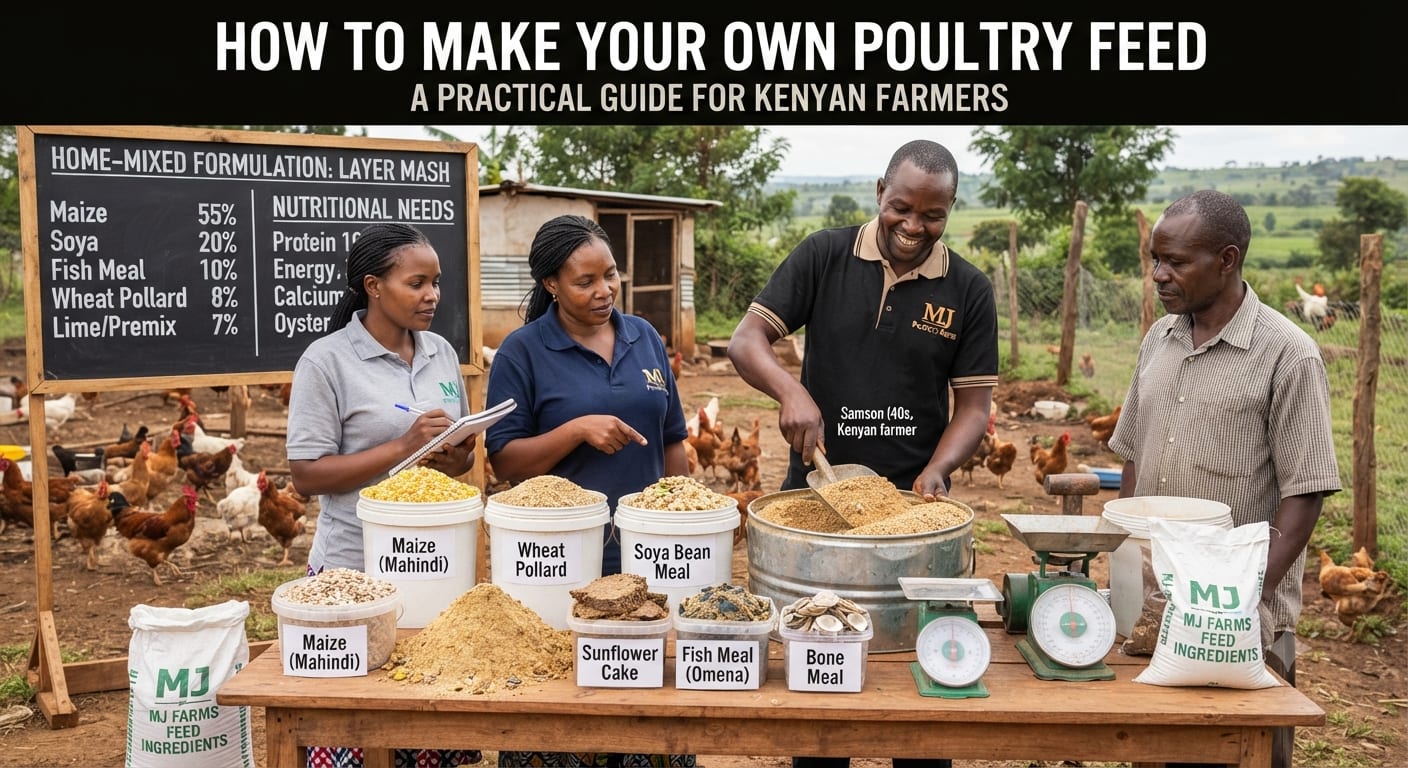
Maize (corn): High in energy (3.3 kcal/g), staple base for all stages.
Wheat pollard: Moderate protein (12-14%) and energy (3.0 kcal/g).
Sunflower cake: Protein-rich (35-40%), but limit to 10-15% due to anti-nutrients.
Soya bean meal: Premium protein source (44-48%), ideal for chicks and layers.
Fish meal: High in protein (55-65%) and calcium; suitable for layers.
Bone meal: Primary calcium and phosphorus source for eggshell formation.
Oyster shells: Cheap calcium supplement for laying hens.
Formulating a Balanced Ration
Calculating Protein Levels
Use the Pearson Square Method for simplicity:
Identify your target protein (e.g., 18% for layers).
Select two ingredients (e.g., maize at 9% protein and sunflower cake at 35%).
Calculate ratios:
Difference between sunflower cake and target: 35% - 18% = 17%
Difference between target and maize: 18% - 9% = 9%
Ratio: 17:9 → 65% maize, 35% sunflower cake
Sample Formulations
Layer Feed (16% protein):
50% Maize
20% Sunflower cake
15% Wheat pollard
10% Fish meal
4% Bone meal
1% Oyster shells
Chick Starter (20% protein):
40% Maize
30% Soya bean meal
15% Wheat pollard
10% Fish meal
4% Bone meal
1% Vitamins/minerals
Feed Mixing and Storage
Equipment for Small-Scale Mixing
Manual: Use a clean wheelbarrow and shovel for small batches.
Mechanical: Invest in a portable drum mixer (KES 15,000–30,000) for consistency.
Avoiding Contamination
Store ingredients in dry, rodent-proof containers.
Clean equipment regularly to prevent cross-contamination.
Use feed-grade limestone dust to absorb moisture.
Safe Storage Practices
Store finished feed in airtight containers to prevent mold.
Consume within 2–3 weeks to maintain nutrient integrity.
Add propionic acid (KES 500–800 per liter) as a preservative if bulk storage is necessary.
Costing Your Ration
Comparison with Commercial Feeds
Ingredient
Cost per kg (KES)
Quantity in Layer Ration
Maize
35
5 kg
Sunflower cake
60
2 kg
Wheat pollard
50
1.5 kg
Fish meal
120
1 kg
Bone meal
80
0.4 kg
Oyster shells
40
0.1 kg
Total cost per kg: KES 45.50 vs. commercial layer feed at KES 60–75/kg.
Savings Per Bird
For 1,000 layers consuming 120g/day:
Annual cost: KES 16.4M (commercial) vs. KES 13.3M (home-mixed)
Savings: KES 3.1M/year or KES 3,100 per bird annually.
Conclusion
Home-mixed feed offers Kenyan poultry farmers a viable solution to rising costs while ensuring quality control. By understanding nutritional requirements and local ingredient profiles, even small-scale producers can optimize flock health and profitability. Experiment with formulations, track performance metrics, and adjust as needed to suit your farm's unique conditions.
Call to Action: Have you tried making your own poultry feed? Share your formulations and experiences in the comments below, or reach out with questions about balancing rations for specific poultry types!